
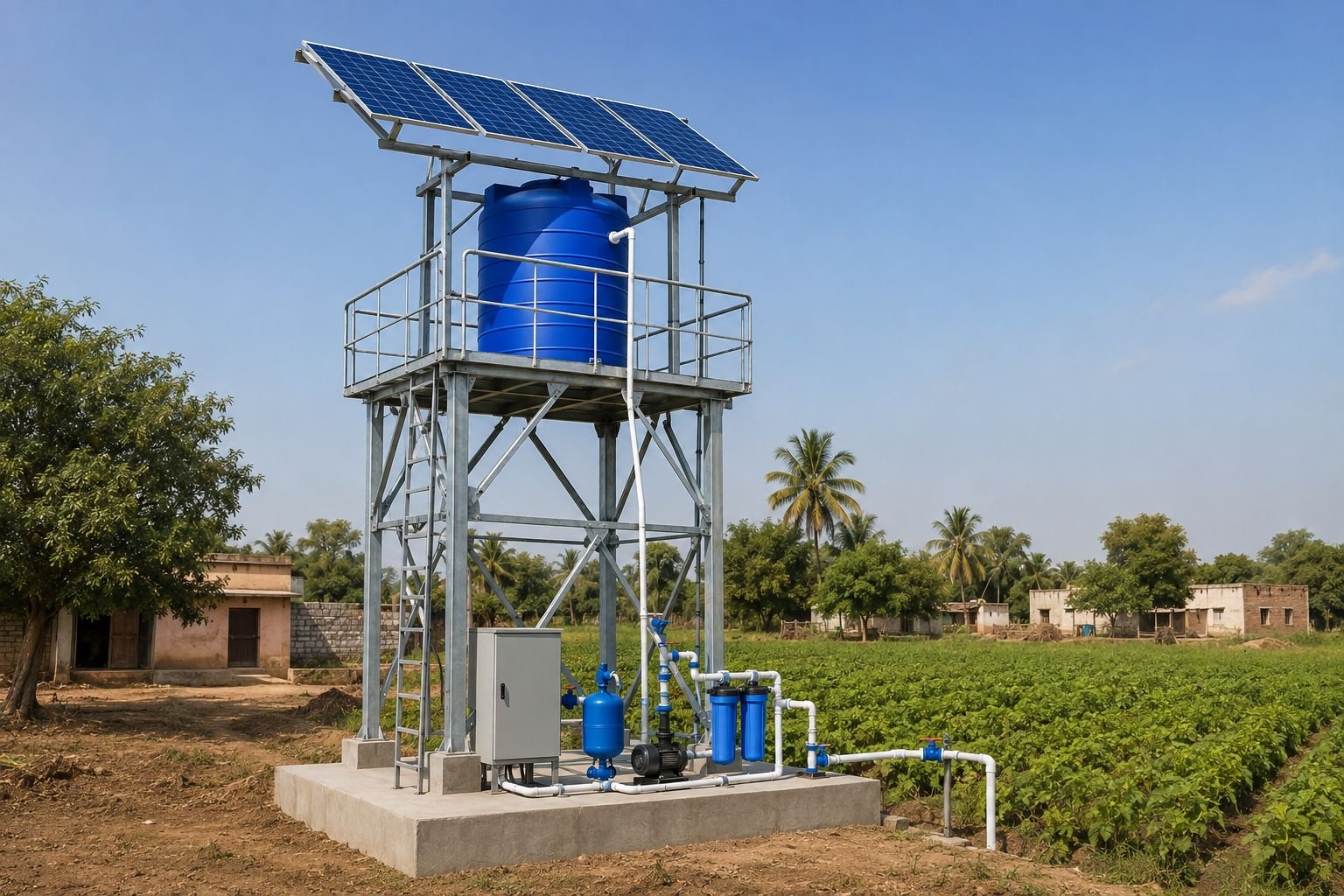
Reliable access to water remains a major challenge for many rural communities. Villages often depend on distant water sources, diesel-powered pumps or an unreliable electricity supply. A solar water tower provides a practical solution by combining solar power, a water pump, a storage tank and an elevated supporting structure. The system uses sunlight to pump and store water during the day, making it available for households, farms, livestock and community facilities whenever needed.
Solar panels generate electricity from sunlight and supply power to the water pump. The pump draws water from a borewell, well, pond or another suitable source and transfers it into an elevated storage tank. Water is then distributed through connected pipelines using gravity.
Because water is stored in the tank, it can remain available during cloudy periods, at night or when the pump is not operating. The required tank capacity and solar power depend on the village population, daily water demand, pumping depth and available sunlight.
A properly designed solar water tower can provide consistent access to stored water. It reduces dependence on irregular grid electricity and helps communities manage essential water needs more efficiently.
Solar energy is freely available and does not require recurring fuel purchases. After installation, the system can significantly reduce electricity and diesel expenses associated with conventional pumping methods.
Solar water towers are particularly beneficial in isolated areas where electrical infrastructure is unavailable or difficult to extend. They operate independently and can be installed close to the required water source.
The elevated tank stores water pumped during daylight hours. This stored supply can be used in the evening or early morning without continuously operating the pump.
Solar water tower systems have relatively few moving parts. Regular panel cleaning, pipeline inspection, tank cleaning and pump maintenance can help ensure reliable long-term operation.
Before installing the system, the water source should be tested for availability and quality. The project should also consider pumping depth, daily water consumption, tank size, tower height, pipeline length and local weather conditions.
The supporting structure must be strong, corrosion-resistant and designed to handle the full weight of the water tank. It is also important to understand that solar pumping does not automatically purify water. Appropriate filtration or treatment may be required when the water is intended for drinking.
The solar water tower benefits for rural areas include reliable water storage, lower operating costs, clean energy use and reduced dependence on conventional electricity. With proper planning, quality components and professional installation, solar water towers can improve everyday water access and support the long-term development of rural communities.
WhatsApp us